ABOUT THE PROJECT
Context
Current situation
- EU requires phytosanitary certificates for imported plants.
- Inspection rate very low (~3%) due to time & cost.
- Confirmatory molecular tests cost €50–100 each → €15–40M/year.
Problem
- Increasing inspections to 90% with current methods → very expensive: €0.45–1.2B/year.
- Lack of efficient tools for early detection of invasive pests.
Opportunity
- senseApest proposes the use VOC signatures from plant–pest interactions.
- Rapid, reliable, and cost-effective detection is needed → potential 70–90% savings (€0.31–1.08B/year).

ABOUT THE PROJECT
Summary
The current plant inspection process is labour intensive due to visual assessments, low detection throughput and the need for physical sampling for molecular- or antibody-based detection kits.
SenseApest will address these challenges by screening imported plant material systematically and efficiently with a non-contact portable detection unit (PDU), based on volatile organic compound (VOC) emissions.
Plants release VOCs in response to pest attacks, while pests emit their own distinctive VOCs. In senseApest, we propose to exploit these VOC biomarkers to develop a high throughput PDU equipped with VOC sensors, an algorithm, and a database. The PDU will enable rapid (<15 min), non-invasive and non-destructive screening of imported plant material for serious pests.
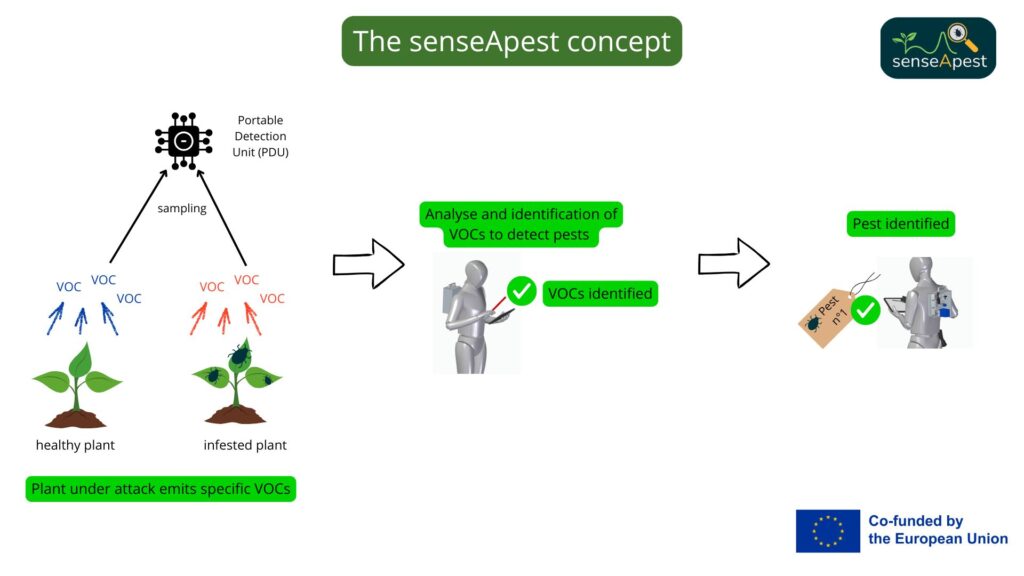
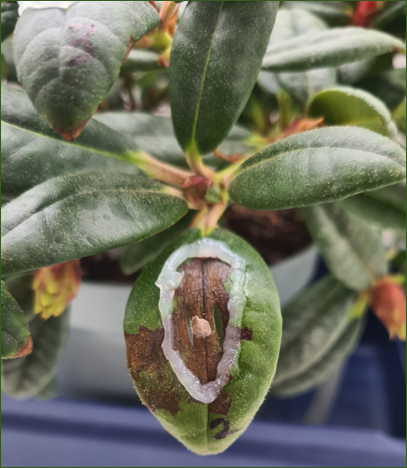
The project emphasizes in the design of the PDU :
- high-accuracy
- user-friendliness cost and time-efficiency
- portability
Two analytical modules will be developed to detect a wide range of VOCs, adding a layer of specificity to broaden the spectrum of detectable pests.
Miniaturized components will be integrated into the PDU, ensuring high analytical performance while maintaining portability. The PDU will be validated into operational environments (TRL7). The collected data will train an algorithm in recognizing pest specific VOC biomarkers, enhancing diagnostic accuracy and applicability. The project aims to reduce false positives and false negatives in pest diagnostics while providing a method prioritizing efficiency in terms of analysis time and unit cost. Ultimately, the PDU is intended to be a cost-effective, user-friendly, adaptable, and efficient tool for plant health inspectors during import controls. To achieve this, a multi-actor interdisciplinary approach will be implemented.
Adopting the PDU is expected to save the EU €0.31–1.08 billion a year, while inspecting 90% of imported plants to limit the risk of plant pest invasions.
Photo Gallery of senseApest